
Intelligent design of dimensions of reinforced concrete frame structure components using diffusion models
Published in: Computers in Industry, 2026
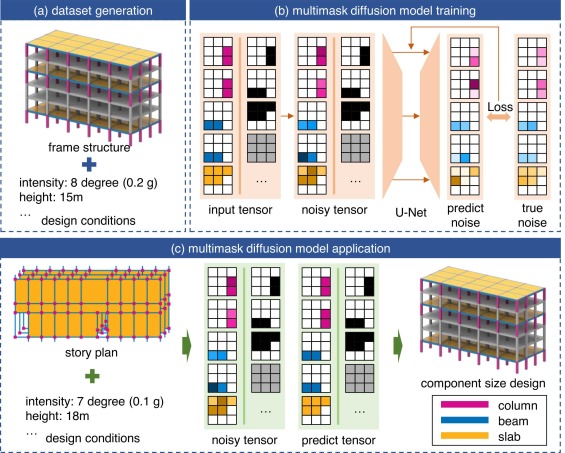
Designing the component dimensions of reinforced concrete (RC) frame structures is a crucial aspect of structural design. However, the reliance on manual expertise results in low design efficiency and unstable quality. The use of heuristic optimization and artificial intelligence algorithms such as generative adversarial networks (GANs) and graph neural networks (GNNs) can enhance design quality and efficiency. However, heuristic optimization algorithms are slow, and the accuracy of GANs and GNNs is insufficient. Therefore, this study proposes a diffusion model-based method called frame-dimension diffusion for predicting the component dimensions in RC frame structures. By integrating multichannel masking and gradient-weighted correction, this model enhances the precision and robustness of the component dimension predictions for beams, columns, and slabs. Furthermore, a new dataset construction method is introduced that captures the key standard story features and seismic conditions to facilitate the learning process of the diffusion model. Through comprehensive experimental evaluations and case studies, the effectiveness of the proposed method has been demonstrated. Compared to heterogeneous GNNs, the prediction accuracy has improved by 33 %. Additionally, the inter-story drift ratio results align with engineer-designed specifications, and the material usage error is within 1 %.
Recommended Citation: Gu, Y., Qin, S.Z., Liao, W.J., Lu, X.Z., 2026. Intelligent design of dimensions of reinforced concrete frame structure components using diffusion models. Computers in Industry 175, 104428. https://doi.org/10.1016/j.compind.2025.104428
PaperURL